
Blackjack Ace Value Explained: What Do 2 Aces Mean?
Blackjack is a card game played in many UK casinos, both online and in person, where the aim is to try and have a hand value closer to 21 than the dealer, without going over.
Aces are the most flexible cards in the game, and having two of them can create a situation that often confuses players who are new to blackjack.
This guide explains how aces are valued, how two aces can interact in a single hand, and the options available if you are dealt a pair. Understanding these details may help you make more informed decisions when playing and give insight into the mechanics of the game.
What’s The Standard Value Of An Ace In Blackjack?
In blackjack, an ace can be counted as 1 or 11. The value used depends on what might keep the total hand at 21 or below.
For example, if you have an ace and a 7, the hand can be considered as either 8 or 18. If adding 11 would result in a total exceeding 21, the ace is automatically counted as 1. This flexibility distinguishes aces from other cards, which always have a fixed value (2–10 as face value, and face cards as 10 points).
Blackjack games can vary, so some online or land-based tables may have subtle differences in how aces are treated, particularly in special variants. Checking the rules or paytable for a specific game can help clarify these differences.
How Do Two Aces Work Together On Your Hand?
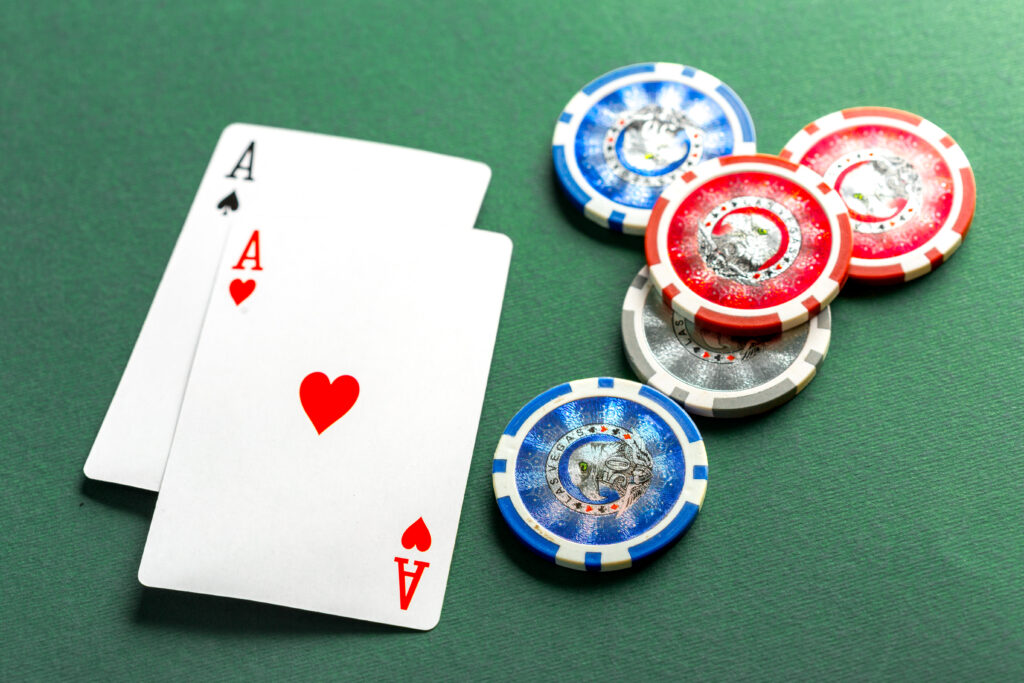
When you are dealt two aces as your starting hand, you have a pair. Counting both aces as 11 would total 22, which exceeds 21, so the hand is considered as 12 — one ace counts as 11 and the other as 1.
Many UK blackjack games give you the option to split the pair:
- Splitting separates each ace into a new hand.
- You place an additional bet equal to your initial stake.
- Each ace then receives one additional card.
Some tables may impose restrictions after splitting, such as allowing only one extra card per ace or not permitting further splits if another ace appears. Rules can differ between casinos and game variants, so you may want to check the details for each table.
Can Two Aces Give You A Blackjack?
A blackjack is defined as a two-card hand consisting of an ace and a 10-point card (10, Jack, Queen, or King), giving a total of 21. Two aces do not meet this definition because their combined value is 2 or 12.
If you split the aces and one of the new hands receives a 10-point card, the hand totals 21. In many UK games, this is treated as a standard 21, rather than a natural blackjack. Payouts for a 21 after splitting may differ from those for a natural blackjack, depending on the table rules and the casino variant.
How To Play A Hand With Two Aces?
If a casino allows you to keep the pair together, the total would be 12. Many players find this hand challenging because it is difficult to reach a strong total without exceeding 21 if additional cards are drawn.
Splitting often provides two separate starting hands, which allows each ace to combine with a new card. The decision to split or not may be affected by:
- How many additional cards are permitted after splitting.
- Whether re-splitting aces is allowed.
- The amount of your original bet and the additional stake required.
Each option carries potential outcomes, and no action guarantees a winning hand. Games are governed by chance, so the results of any hand are uncertain.
Play Blackjack Online
If you are keen to experience blackjack for yourself, O’Reels offers an online casino platform licensed by the UK Gambling Commission (UKGC). You will find a selection of blackjack games, from classic layouts to modern variants with different table rules, so you can choose the style that suits you.
Exploring the games at O’Reels is straightforward. Log in or join to see the full selection, check the rules for each table, and pick a game that fits how you like to play.
Gambling is entertainment. Please set limits that work for you and use support tools if you need them.
*All values (Bet Levels, Maximum Wins etc.) mentioned in relation to these games are subject to change at any time. Game features mentioned may not be available in some jurisdictions.
**The information provided in this blog is intended for educational purposes and should not be construed as betting advice or a guarantee of success. Always gamble responsibly.